
- What Are AI Overviews and How They Impact SEO in 2026
- What Are AI Overviews and How They Impact SEO
- Why GEO and AEO Matter More Than Ever
- What Is Generative Engine Optimization (GEO)?
- What Is Answer Engine Optimization (AEO)?
- What This Means for Businesses in 2026
- AEO vs GEO – What’s the Difference?
- Why Generative and Answer Engine Optimization(GEO/AEO) is The Best Marketing Strategy in 2026
- How Brands Can Rank Inside AI Overviews
- How to appear in AI features
- The Future of SEO Strategy
- Final Thought
- Frequently Asked Questions FAQ's
What Are AI Overviews and How They Impact SEO in 2026
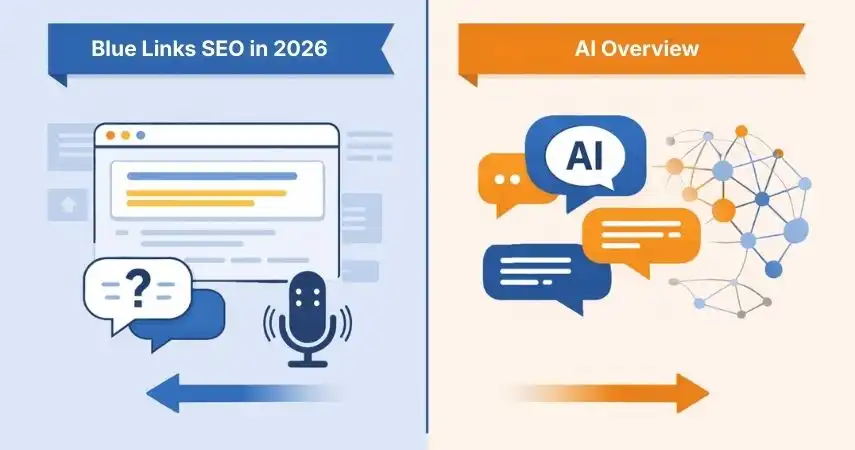
Future of SEO, AI Search Optimization & Zero-Click Visibility. Search doesn’t look the same anymore. Blue links are fading. Clicks are shrinking. With the rise of AI-powered search results, Google AI Overviews, and AI search optimization, the future of SEO in 2026 is rapidly moving toward zero-click searches and AI-first Search Engine Optimization strategy.
Today, users want instant clarity. These systems now deliver structured responses before anyone even opens a website. If your brand isn’t visible inside those answers, you’re invisible in modern search.
A few years ago, ranking on page one meant traffic, leads, and growth. Today, the rules are changing fast. AI-powered search experiences are reshaping how people discover information, compare options, and make decisions.
This shift has introduced new optimization models like Generative Engine Optimization (GEO) and Answer Engine Optimization (AEO). These aren’t trends. They are becoming the foundation of how AI-first SEO strategy works SEO in 2026.
People no longer scroll endlessly through ten blue links. They expect instant clarity. Structured answers. Trusted sources. And search engines are delivering exactly that through AI Overviews and AI-generated responses.
If you want your content, brand, or website to stay visible in this new environment, you must understand how AI search works and how GEO and AEO shape modern SEO strategy.
AI has already changed the world in how we see it. With the rising advancements of technology, especially in AI, terms like Generative Engine Optimization (GEO) and Answer Engine Optimization (AEO) have made their place in one of the most important terms in 2026.
The way people search on search engines have found a new look ahead to the start of 2026 year.
What Are AI Overviews and How They Impact SEO
Google AI Overviews shine at the top of the result page, delivering AI-generated answers that improve search visibility and support zero-click SEO behavior. leaving information seekers with already a structured answer followed by the bullet points, which is usually sourced through a link published below.
Google AI Overviews officially launched in the USA in May 2024. Previously tested as the “Search Generative Experience” (SGE) starting in May 2023, this generative AI feature provides summarized answers at the top of search results and was rolled out to all U.S. users in May 2024.
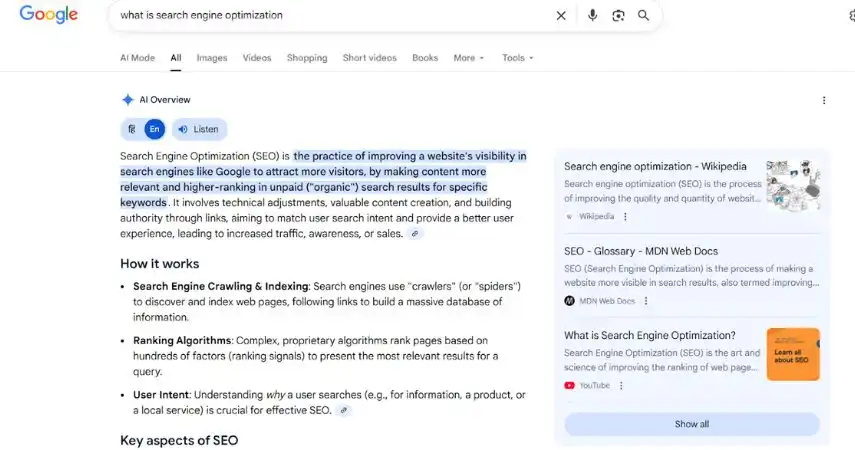
AI overviews show up on queries and searches and provide a summarized benefit to the query, providing relevant answers to the explorer. This function has improved the search experience by providing multiple links in its answer for relative information.
If you want your website to stay visible in generative search environments, you must understand how GEO and AEO shape modern SEO strategy. Traditional keyword chasing is losing power. Visibility now depends on clarity, authority, and usefulness.
Furthermore, people have been visiting a greater diversity of websites for complex questions.This benefits both readers and marketers, by providing them more exposure to each other.
Why GEO and AEO Matter More Than Ever
So the best possible writing and SEO strategy of 2026 is clear and straight! If you want your brand or link to outshine them all, you definitely need to land in the description provided by the AI overviews! You rank in the overviews results, You Rank Highest! But, before starting it is important to understand what is – AEO, GEO, and what is the difference between the two!
What Is Generative Engine Optimization (GEO)?
Generative Engine optimization (GEO) is the part of SEO strategy that aims to create citation-worthy content and win visibility at the top of the search result page in the AI overview section (like ChatGPT/Google SGE).
GEO content:
- Explains concepts clearly and completely
- Provides factual, up-to-date information
- Covers a topic in depth, not just one keyword
- Is written to be quoted, summarized, and referenced
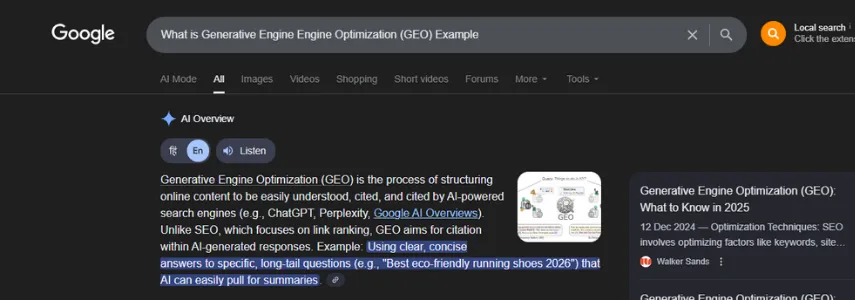
In addition to GEO, AEO (Answer Engine Optimization) strategy tries to build content that directly answers frequently asked questions by readers in clear, structured, and point format to gain visibility in the “people also ask for” section at the middle of the search result page.
What Is Answer Engine Optimization (AEO)?
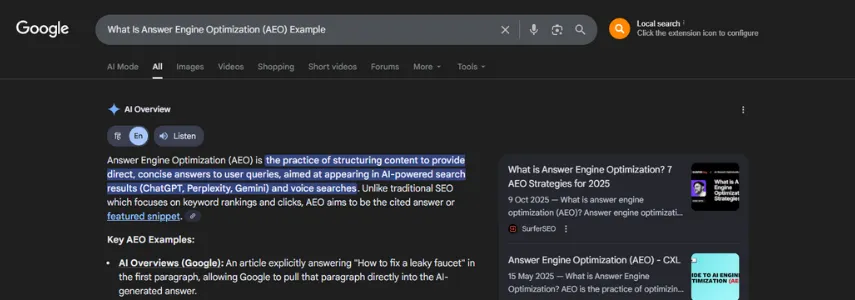
Answer Engine Optimization, or AEO, means creating content that gives direct answers. Not long talks. Just what people are actually asking for.
Today, people don’t search. They ask. On Google. On voice search. On AI tools. They want quick replies, not ten links to open.
AEO helps your content become that answer. You write in simple language. Clear questions. Short responses. Easy for humans. Easy for machines too.
Imagine someone typing a question late at night, confused, in a hurry. Your page shows up and solves it. That’s the win.
It’s still about good content. Just smarter. A little messy sometimes. More real. More helpful.
- Targets frequently asked questions
- Provides concise, accurate responses
- Uses clear headings and structured formatting
- Performs well in “People Also Ask” and featured snippets
What This Means for Businesses in 2026
What this means for users
AI Overviews reduce friction. People get faster answers and clearer context, especially for research-heavy queries.
What this means for brands
According to Google’s own documentation, AI features are designed to surface a wider diversity of sources, particularly for nuanced questions. That means visibility is no longer limited to whoever ranks #1.
If your content is useful, structured, and trustworthy, it can be cited even if you weren’t previously dominating the SERP.
This is where GEO and AEO matter. Since, both of them are a result of recent AI advancements, it is just not a trending topic that you should simply hop on or adapt.
Rather, it is the new strategy that marketers are following to give a boost to their content and enhance visibility. Below are the exact reasons for why you should adopt Answer Engine Optimization and Generative Engine Optimization in 2026.
AEO vs GEO – What’s the Difference?
At first glance, AEO and GEO sound similar. Both focus on visibility inside AI-powered search. But their goals and execution are slightly different.
AEO is about answering specific questions clearly and quickly. It helps your content appear in featured snippets, People Also Ask boxes, and voice search results. The main goal is to deliver direct answers in a clean format.
GEO, on the other hand, focuses on becoming a trusted source for AI systems. Instead of only answering one question, GEO builds deep topic authority so AI can quote, summarize, and reference your content inside AI Overviews and generative answers.
In simple terms, AEO wins micro-moments. GEO wins long-term visibility.
Both work best when used together.
AEO vs GEO Comparison Table
Factor
Primary goal
Focus
Best placement
Content style
Search intent
Traffic behavior
Optimization method
AEO (Answer Engine Optimization)
Answer questions directly
Short, clear answers
Featured snippets, People Also Ask
Structured, concise, FAQ-based
Informational, quick answers
Often zero-click or fast clicks
Schema, headings, formatting
GEO (Generative Engine Optimization)
Become a trusted citation source
Deep topic coverage and authority
AI Overviews, AI-generated answers
In-depth, explanatory, contextual
Research, comparison, discovery
Brand visibility and trust building
Entity SEO, topical authority, citations
Example of AEO
Someone types on Google.
“How do I fix a leaking tap?”
They don’t want a long article. They want the answer. Fast.
Your page shows a simple line at the top.
“Tighten the valve under the sink. If water still leaks, replace the washer.”
Done. Problem solved.
Below that, you add a short step list. One photo. Maybe a quick tip. Easy to read. No confusion.
Google picks that clear answer and shows it directly in the result. Even voice search reads it out loud sometimes.
That’s AEO working.
Not fancy. Not complicated. Just giving the right answer at the right moment.
Example of GEO
Someone searches on Google.
“Best laptop for students in 2026.”
They’re confused. Too many options. Too many reviews.
Your article doesn’t just list products. It explains clearly. Short lines. Simple words. A quick comparison. Battery life. Price. Real use.
At the top, AI picks your paragraph and shows it as a summary. A neat answer box. The user reads it before clicking anything.
Your brand name shows there. Quietly. But powerfully.
That’s GEO in action. You’re not chasing traffic only. You’re becoming the source the AI trusts. Feels small. But it makes a big difference.
AdityaWrite clear questions, give short direct answers, and keep language simple so AI can easily understand your content and show it in search results.
Why Generative and Answer Engine Optimization(GEO/AEO) is The Best Marketing Strategy in 2026
The new search mode is doing an excellent job when it comes to answering complex questions where further reasoning, exploration, and comparisons are needed. AI powered response provides a comprehensive search result with links to supporting websites so that people can easily navigate and find relevant sites without having to work much.
AI Handles Complex Queries Better Than Ever
AI search excels at questions that require reasoning, comparison, or exploration. Instead of forcing users to open five tabs, AI Overviews summarize insights and point users to relevant sources.
Google has stated that these features are designed to help users navigate to helpful sites faster, not replace them
Brand Visibility in AI Search
The very first reason why this is a rising opportunity for your brand is the golden chance of gaining brand visibility through AI search. When AI finds your content, information and site worthy and genuine, they simply add your link in its description.
This exposes your brand directly to your consumers, right before even they scroll down the page.
Great SEO Strategy
People love rankings! With your site being listed in the AI overview description at the top of the search result page, you are sure to earn those high Search Engine Optimization rankings with zero-click SEO strategy.
Be it awareness, selling, converting, acquiring leads, you can put all your eggs in one basket when it comes to working with generative AI. If you are willing to acquire your spot in the top rankings, your next SEO strategy must include citation-worthy content that ranks in AEO and GEO.
Builds Brand Trust
Readers have eased up with AI overviews for telling them relevant information already. When they see your brand popping up in the overview section, it immediately gets the reader’s attention and trust.
Furthermore, when you accurately answer their queries through AEO and citation-worthy content, this builds your brand’s credibility.
Brings out More Conversions
Content that is optimized for SGE/ AI-first search, naturally tends to draw more clicks and thus – more conversions. When your brand is already serving people what they need, consumers are drifting towards your brand.
With simpler SEO strategies, you are expected to get results through clicks and thus bringing conversions is linked to additional steps.
Presenting your brand at the zero step through AEO and GEO gives you a step ahead and brings better conversion rates. By the time they click, they’re deeper in the decision process.
How Brands Can Rank Inside AI Overviews
How To Master Answer and Generative Engine Optimization
Build Topical Authority for AI Search
AI search engines use a process often referred to as query fan-out. Instead of answering only the exact query, the system explores:
- Related subtopics
- Adjacent questions
- Supporting concepts
If your site consistently covers a topic from multiple angles, AI systems are more likely to see it as a reliable source. Topical authority beats isolated articles every time.
Focusing on topics, not keywords
Keyword stuffing is obsolete in Modern search
- Context
- Depth
- Intent alignment
Rather than asking “What keyword should I rank for?”, ask: What problem is the user trying to solve? What do they need to understand next? What would make this answer complete?
Optimize for Search Intent
If you want to see success with your AI search strategy in 2026, you need to focus on search intentions. This is a big shift that’s happening in the search world, and a lot of it is due to AI search engines. Search has shifted from what people type to why they search.
A single query can represent:
- Research intent
- Comparison intent
- Decision intent
Your content should acknowledge that journey and guide the reader through it naturally.
Stay ahead with future-proof SEO
How to appear in AI features
Google has been clear: there are no special shortcuts for AI Overviews. To be eligible as a supporting link:
- Your page must be indexed
- Googlebot must not be blocked
- The page must return a 200 status code
- The content must be indexable and helpful
There are no extra technical requirements beyond standard Search best practices.
Helpful, people-first content still wins.
You can apply the same foundational SEO best practices for AI features as you do for Google Search overall: making sure the page meets the technical requirements for Google Search, following Search policies, and focusing on the key best practices, such as creating helpful, reliable, people-first content.
The Future of SEO Strategy
Key SEO and Content Strategies to Rank in Generative Engine Optimization in 2026
To summarize, successful AI-first SEO strategies focus on:
- Citation-worthy content
- Zero-click SEO visibility
- Strong topical authority
- Brand visibility in AI search
- Answer Engine Optimization (AEO)
- Optimization for AI Overviews and AI Mode
- Entity-based SEO and knowledge graph alignment
Final Thought
SEO in 2026 isn’t about chasing algorithms. It’s about earning trust at scale.
AI didn’t kill search. It raised the bar.
Brands that win will be the ones that explain better, structure smarter, and genuinely help users understand what they’re searching for.
Frequently Asked Questions FAQ's
SEO in 2026 is no longer just about ranking blue links. It focuses on visibility inside AI-powered search results like AI Overviews, featured snippets, and generative answers. Traditional keyword-first SEO is being replaced by intent-based, entity-driven, and citation-worthy content strategies.
AI Overviews are AI-generated summaries that appear at the top of Google search results. They provide structured answers sourced from multiple trusted websites, often reducing the need for users to click on individual links.
AI Overviews increase zero-click searches, meaning users often get answers without clicking through to websites. However, brands featured inside AI Overviews gain higher visibility, authority, and trust, often leading to better-qualified clicks and conversions.
Generative Engine Optimization (GEO) is the practice of creating in-depth, authoritative, and citation-worthy content that AI systems can quote or reference inside AI Overviews and generative search results.
Answer Engine Optimization (AEO) focuses on structuring content to directly answer user questions clearly and concisely. It helps content appear in featured snippets, People Also Ask sections, and voice search results.
AEO targets quick, specific answers for immediate visibility, while GEO builds long-term topical authority so AI systems trust and cite your content. AEO wins short answers. GEO wins broader AI-generated summaries. Both work best together.
Keywords still matter, but they are no longer the primary focus. Context, intent, topical depth, and usefulness now play a bigger role than exact keyword matching in AI-first search environments.
Zero-click SEO refers to optimizing content so it gains visibility and brand exposure even when users don’t click through to a website. This happens through AI Overviews, featured snippets, and direct answers on the search results page.
Brands can rank inside AI Overviews by publishing helpful, structured, trustworthy, and in-depth content. Pages must be indexed, technically accessible, and aligned with search intent. There are no shortcuts beyond strong content and SEO fundamentals.
Yes. When a brand is cited inside AI-generated answers, users perceive it as a trusted and authoritative source. This increases credibility and improves decision-stage conversions.
Content that explains topics clearly, answers related questions, provides examples, and covers subjects in depth performs best. Citation-worthy, people-first content is more likely to be referenced by AI systems.
GEO and AEO are not short-term trends. They represent a structural shift in how search engines work and how users consume information. They are becoming foundational to SEO strategy in 2026 and beyond.